Tamperelaisen Pihlajalinnan toimitusjohtaja uhoaa tänään, että Merilapin kaltaiset tapaukset tulee lisääntymään. Hallitus kuulemma ei voi mitään sille, että kunnat haluavat yksityistää terveydehuollon.
Kokoomus on kaiken takana. Ihmetellä täytyy, kuka tavallinen palkansaaja vielä äänestää kokoomusta.
Nyt on myös demarien nokkamies Antti Rinne ottanut voimakkaasti kantaa hallituksen sote-esitykseen. Demarit eivät tule hyväksymän sitä, että Kepu ja Kokoomus ovat tehneet lehmänkaupat, jossa Kepu saa maakuntauudistuksen ja Kokoomus yksityiset lääkärifirmat pääsevät valtion varoihin käsiksi.
Kysmyksessä on suuri puhallus, jossa yksityiset lääkärifirmat Kokoomuksen tuella kaappavat koko Suomen terveydenhuollon. Noin 20 miljadia euroa verovaroja siirtyy veroparatiiseihin. JA HINNAT TULEVAT TAKUULLA NOUSEMAAN MEILLE KANSALAISILLE.
Toivottavasti perustuslaki torppaa koko sotehankkeen.
Ennustan, että ennen, kuin suo sulaa hallitus kuolee. Uudet vaalit ovat välttämättömät, jotta kansa saa sanoa mielipteensä sotesta. Se on niin suuri asia, että sitä ei voi päättää vain kaksi puoluetta ja heidän uskolliset ja nöyrät myötäjuoksiJansa loikkarinsiniset.
Informaatiovaikutusta tai -sotaa, ahdistelusyytöksiä ja ahdisteluun syyllistyneitä, veronkiertäjiä ja oman elämänsä sankareita. Mikäli ruoaksemme riittäisivät lööpit olisimme paksumpia kuin koskaan. Informaatioähky ei ehkä näy vatsassa vaan päässä, mutta minun päähäni sattuu eniten ajatus siitä että valtio tai EU voisi hoitaa ajattelun puolestamme.
Paljonko huudosta on tyhjää?
Esitän ensin kysymyksen ja spekulaation. Kun puhutaan viime aikojen isoista jutuista, kuten seksuaalinen häirintä, paratiisin paperit tai USA:n vaaleissa vaikuttaminen, kuinka paljon näistä on syntynyt täysin tyhjän päälle? Kuinka paljon esim. Clintonin tai Trumpi vastaiset lööpit ovat rakentuneet ilman mitään todellisuuspohjaa? Väitän että puhtaat valheet ovat sangen pieni vähemmistö metelistä. Toki jutut ovat päätyneet usein sivuraiteille ja ison jutun vetovoimalla matkustavat myös mielikuvituksen tuotteet, mutta itse isossa jutussa on mielestäni aina vähintään hieman faktoja taustalla. Tullaanpa hetkeksi lähemmäksi ja puhutaan EU:n huolesta populistipuolueiden osalta. Ovatko populistit vain valheella ratsastavia tuholaisia, vai voiko niiden asiassa olla myös totuuden siemen? Mielestäni edes trollisavua ei ole ilman pientä tulta, tai vähintään kipinää. Lisäksi esitän soppakattilan pohjalle vielä yhden valmistusaineen: huhuja on ollut aina. Ihminen ei ole oppinut valehtelemaan vasta Internetin myötä.
Huolestuminen ei ole huono asia. Kyllä minua huolettaa ajatus siitä, että maamme ottaa takapakkia vaikkapa seksuaalivähemmistöjen oikeuksissa, tai että yritysvihamielisyys tuhoaa hyvinvointivaltion pohjan. Populismi, niin politiikassa kuin muuallakin, on hälytyssireeni. Se tarkoittaa että jotain on mennyt vikaan. Älyllinen reaktio on tutkia syitä, varmistaa niiden olemassaolo, selvittää niiden synty ja tehdä ratkaisuehdotus. Mielestäni niin Suomen johdon, EU:n kuin muidenkin korkeiden elinten vaientamisreaktio on sanalla sanoen älytöntä. Jos katsotaan vain välitöntä, yksittäistä tilannetta, on epäilemättä kaunis ajatus poistaa kansalaisten korvista vähään totuusarvoon perustuvia huuteluja. Se ei kuitenkaan ole taloudellisesti tehokasta eikä yhteiskunnallisesti kestävää. Kun valtiovalta ryhtyy mainostamaan kansalaisille ns. yhteisen hyvän totuutta, se voi vain epäonnistua hirveästi tai vielä pahemmin.
Kun tämä ongelma puretaan tarpeeksi pieniin osiin, keskiössä on ajatteleva ihminen. Ihmiselle on luonnollista ajatella eikä ajattelun kieltäminen voi toimia. Siinä tulevat jo geenitkin vastaan. Parempi ratkaisu olisi tukea tätä ajattelua, rohkaista elinikäiseen uuden oppimiseen, kasvattaa nahkaa ja opettaa terveen skeptisyyden parhaat puolet. On aiheellisesti sanottu että ansaittu leipä maistuu paremmalta, vaan sama pätee myös ajatustoimintaan. Tutkimalla ja oppimalla hankittu ratkaisu maistuu makoisalta siinä missä valmiiksi pureskeltu vastaus on kuivaa. Eihän matematiikan tunneillakaan päntätä ulkoa yhtälöiden tuloksia vaan opetellaan niiden ratkaisemista. Yhteiskunnan hahmottaminen on samaa logiikkaa vaativaa ajattelua ja tietänemme ettei yhden Pravdan malli johda onnelaan.
Juhlistakaamme järjenkäytön saavutusta
Vaikkakin maltilla ja järjellä rakennetusta koulujärjestelmästämme ollaankin tekemässä kikkailujen koelaboratoriota, on pohja jalkojemme alla yhä melko vakaa. Olemme kouluttaneet kansaamme käyttämään järkeä. Arvon päättäjät, se on hyvä asia. Se on voimavara jota ei pidä hyödyntää vain talouskasvun juhlapuheissa, vaan yhteiskuntamme jatkuvassa kehityksessä. Meillä ON fiksu kansa joka osaa ajatella. Sen sijaan että lähtisitte sotaan ajattelua vastaan, ruokkikaa tätä voimavaraa. Rohkaiskaa ajattelua, juhlistakaa sitä, nostakaa hattu monen sukupolven mittaiselle työlle jonka ansiosta kansamme osaa erottaa huhut faktoista. Jotkut teistä päättäjistä pelkäävät ajattelevaa kansaa, vaikka juuri se pitää teistä suoraselkäisimmät virassa ja antaa teille mahdollisuuden tehdä pitkäjänteistä politiikkaa. Sota ajattelua vastaan on vain korruptoituneen päättäjän etu, eikä yhdenkään vastuullisen toimijan pitäisi moista harkitakaan.
Jotta ei nyt mennä historiassa määräänsä pidemmälle, todettakoon että esimerkiksi koko Neuvostoliiton olemassaolon ajan maailmanpolitiikan kaksi suurta tunaria käyttivät mittaamattomat määrät ruplia ja dollareita vaikuttaakseen poliittisiin mielipiteisiin, vaalituloksiin ja mielialoihin. Se ei ole mitään uutta ja olemme jo erittäin tottuneita siihen. Me tiedämme, että raha haluaa puhua saadakseen lisää rahaa ja valta saadakseen lisää valtaa. On kiva, että huolestutte valheista, mutta emme me keskivertokansalaiset nyt ihan niin avuttomia ole mitä annatte ymmärtää.
Vain 40.000 pystyy oikeasti työllistymään?
Se on ihan eri luku, kuin sadattuhannet sanoo Vartiainen hesari tänään.
– Hän on pitkälti oikeassa sillä enemmistö on työttömiä joille ei kertakaikkiaan ole työtä varsinkaan sellaista joista maksettaisiin oikeasti palkkaa.
– Työnantajat haluavat yhä vähentää työntekijöitä kuten Valkeakoskella Bemis ja saada yhä harvemmilta työntekijöiltä tehokkaamman työtuloksen.
Hallituksen toimet kikyloikkineen lyövät korvalle työttömien työllistämisessä.
– Mitä pitäisi tehdä 300.000 tuhannelle työttömälle – kas siinäpä kysymys?
UBC Psychology professor Kiley Hamlin shares research on early moral cognition with the Dalai Lama
October 22, 2014
Prof. Kiley Hamlin took part in the sold-out event Educating the Heart in the Early Years: A Dialogue with the Dalai Lama on October 22, 2014 at UBC’s Chan Centre for Performing Arts.
Revered worldwide for his compassion, quick wit and intelligence, the Dalai Lama is one of UBC’s most distinguished Honorary Doctorates.
This unique dialogue featured a keynote address by the Dalai Lama and a panel of leading researchers from UBC who discussed the science behind the Dalai Lama’s belief that consciously teaching children to be compassionate and altruistic in their earliest years has a profoundly positive effect on their social, emotional and spiritual well-being throughout life.
Dr. Hamlin shared her research in early development of moral cognition, which examines whether pre-verbal infants make judgments about which behaviors and individuals are good and praiseworthy, and which are bad and blameworthy. Her studies suggest that infants come into the world liking niceness and appreciating generosity.
Photos courtesy of Martin Dee and Michael Krausz.
Revered worldwide for his compassion, quick wit and intelligence, the Dalai Lama is one of UBC’s most distinguished Honorary Doctorates.
Halosen näköinen ja oloinen ruma ämmä oikealla on Kilaus Hämäliini. <:C
Tämä ei ole sattumaa: Lama on kovaa kaveria myös Harvajärkiopiton taannoisen megakäryn Bullshit-Marc Hauserin kanssa:
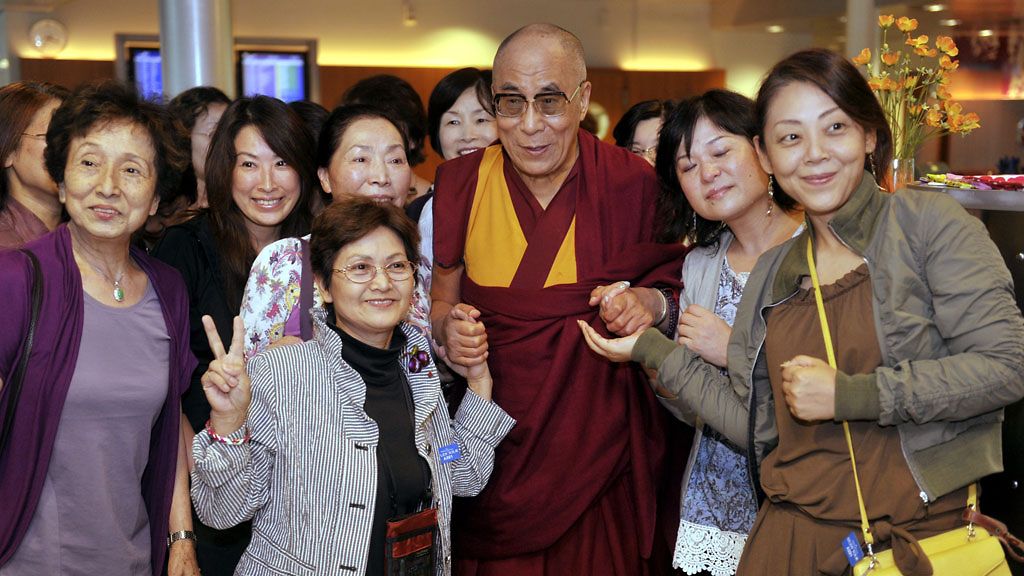
Tiibetin hengellinen johtaja dalai-lama, Tenzin Gyatso, ja japanilaisia turisteja, jotka halusivat yhteiskuvaan dalai-laman kanssa Helsinki-Vantaan lentokentällä.
YLE1:n mukamas ”tiedeohjelma” PRISMA esitti 4., 5. ja 10.11. 2013 otsi- kolla ”Synnymmekö hyviksi? ” (Babies: Born to Be Good?) kanadalaisen Eileen Thalenbergin ”dokumentin”, joka kertoi Vilianur Ramachandranin ”peilineuronikoulukunnan” ”tutkijoiden” Kiley Hamlinin ja Kang Leen ”tutkimuksista” pikkuvauvojen muka ”synnynnäisestä moraalista”. ”Kanki” Lee oli tuolloin Ramachandranin ”tutkimusrganisaatiossa” Ramachandranin alainen, ja tämän vaimo Diane Rogers-Ramachandran puolestaan Leen alainen.
Psykologit ovat alkaneet päästä selville siitä, miten paljon lapsi ymmärtää luonnostaan reiluudesta
4.11.2013 2:00 0
Timo Peltonen, Yle
(Patatyhmä toimittaja ei ole ensinnäkään katsonut ohjelmaa EIKÄ VAR-SINKAAN LUKENUT TEKIJÖIDEN MUKA ”TIETEELLISIÄ TUTKIMUK- SIA”, joissa puhutaan tosiasiassa ROTUMURHAPEILINEURONISTA eikä suinkaan mistään ”yleisestä reiluudesta”!
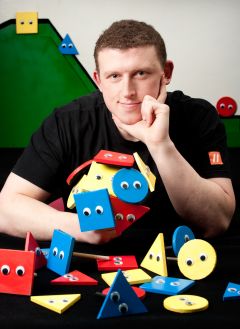
Psykologian professori Kiley Hamlin järjestää viisikuiselle Lindenille nukkenäytelmän, jossa yksi pehmoeläimistä on ystävällinen ja toinen ei.
Synnymmekö hyviksi?
Kanada 2012
Ohjaus Eileen Thalenberg
TV1 klo 19.00
Uusinnat ti 5. 11.
Vanhakantaisen käsityksen mukaan lapsi toimii moraalisesti oikein siksi, että hän pelkää auktoriteetin, vaikkapa Jumalan tuomiota. Ajattelutapa nousi esiin viimeksi syyskuun lopussa Jehovan todistajien lapsille teke- missä nettiopetusvideoissa ja niitä käsitelleissä nettikeskusteluissa.
Höpökäsitys, osoittavat viimeisen vuosikymmenen aikana lapsille teh- dyt psykologiset tutkimukset. Lapsi kykenee erottamaan hyvän teon pahasta teosta jo ennen kuin ymmärtää puhetta kunnolla.
Mainituista tutkimuksista kertoo sujuvasti, antoisasti ja viihdyttävästi tiededokumentti Synnymmekö hyviksi? Tutkimustulosten tulkinnassa se olisi voinut mennä pidemmälle.
Kanadalaisprofessori Kiley Hamlin aloitti tutkimuksensa kymmenkuisis- ta vauvoista ja huomasi heidän erottavan oikeuden vääryydestä.
Sitten siirryttiin kuusikuisiin, sitten viisikuisiin ja lopulta kolmekuisiin vau- voihin. Heidänkin huomattiin säännönmukaisesti katselevan pidempään pehmonallea, jonka he näkivät olevan ystävällinen toiselle pehmoeläimelle.
Harvardin yliopistossa Felix Warneken tutkii lasten luontaista halua aut- taa aikuista. Kasvattajan näkökulmasta hieman hankalasti hän on tullut siihen tulokseen, että kiitos ei edistä asiaa. Ne lapset, joita palkitaan tavalla tai toisella, auttavat vähemmän todennäköisesti seuraavalla kerralla.
Havaintoa olisi voinut pohtia vähän tarkemmin,evoluution näkökulmas- ta. Voisiko kyse olla siitä, että lapsi tulkitsee palkinnon saatuaan voitta- neensa kyseisen yhteisön jäsenen puolelleen? Näin tarve miellyttää vähenee.
Ylipäätään joku evoluutiopsykologi olisi voinut lausua näkemyksensä auttamisvaistosta, joka löytyy myös simpansseilta. [valhe!] Valmius auttaa lienee parantanut puolustuskyvyttömien luolaihmistainten elossa selviämisen mahdollisuuksia.
Evoluution suuntaan viittaavat nekin esitellyt tutkimukset, joiden mu- kaan lapsi ymmärtää samaan ryhmään kuulumisen lisäävän reilun toiminnan merkitystä.
Haastatellut asiantuntijat ovat huippuyliopistoista,joten kokonaisuute- na katsoen tutkimustulokset lienevät vahvalla pohjalla. Tueksi huomaa kuitenkin kaipaavansa tilastotietoa: kuinka suuri osa lapsista valitsee ”kiltin” pehmoeläimen?
Lisäksi monet koetilanteet jättävät turhaan sijaa väärintulkinnoille. Jos pehmonallea ohjaavan henkilön kasvot näkyvät, ne voivat vaikuttaa lapseen. Sama koskee äänenpainojen vaihtelua. Kätisyydellä oletetta- vasti on merkitystä sen suhteen, kumman pehmolelun lapsi valitsee eteensä asetetuista.
Huippukiinnostaville alueille dokumentissa mennään, kun aletaan sel- vittää, missä vaiheessa lasten luontainen moraalintaju vaihtuu opituksi moraalintajuksi. Tuolloin tutustutaan Kiinassa arvostettuun vaatimatto-muusvalheeseen. Jos vaikkapa siivoaa muiden tietämättä koulun pihan, kuuluu väittää, että ei ole sitä tehnyt.
Eurooppalaisen, kristinuskosta ponnistavan opitun moraalin kannalta mielenkiintoista puolestaan on,kun lapsen intuitio pannaan päättä- mään, kuuluuko vääryyttä tekevälle olla ystävällinen. Vastaus on, että ei kuulu.
Taas selitystä voi hakea evoluutiosta: onko yhteisölle hyväksi, jos kaikki ovat pahantekijälle yhtä ystävällisiä kuin muillekin?
Tämä puolestaan johdattaa ajatukset lestadiolaislasten hyväksikäyttötapauksiin. ”
RK: Doku oli puhdasta paskaa. ”Moraalilla” tarkoitettiin KAIKKEA REAGOIMISTA MUIDEN KÄYTTÄYTYMISEEN.
”Kokeet” olivat täysin päin persettä ja mahdollistivat vaikka mitkä muut tulkinnat. Ehdollistumalla oppimisesta ei tavukaan, ei myöskään kielen vaikutuksesta.
Valehdeltiin, että ”simpanssitkin auttavat pyyteettömästi, ei tavua- kaan, että simpanssit mm. ovat kannibaaleja, jotka voivat syödä omasta laumastaankin.
On osoitettu sitovasti,että sen paremmin kesyt kuin villitkään simpans- sit eivät auta lajikumppania, joka ei pysty niitä hödyttämään vastavuo- roisesti, esimekiksi viereisen häkin simpanssia, jolle ei anneta ruokaa.
Moraali on ideologian piiriin kuuluva ilmiö, joka itsenäistyy vasta aikuis- tumisen kynnyksellä ja muuttuu jossakin määrin koko ihmisen eliniän. Se on ”ideologisesti sisäistettyä lakia”.
Ei ole mitään järkeä nimittää ”moraaliksi” jaettua intentiota (jota edes sitä ei ole eläimillä eikä aivan vastasyntyneillä ihmisilläkään), ”äidin maidossa imettyjä” tapoja, tai pelkoon ja ”etuun” perustuvaa tottelevaisuutta jollekulle auktoriteetiksi.
Tekijöiden muka ”reiluusmoraalin” takaa paljastuukin sitä, mitä jokainen varsinainen asiantuntija on aina tiennyt paljastuvat ”peilineuroni”-koohotuksen takaa:
Study: Babies Like Watching Puppets Who Are Different From Them Get Hurt
Nine and fourteen-month-olds prefer ”individuals who treat similar others well and dissimilar others poorly.”
James Hamblin May 7 2013, 10:49 AM ET1
PROBLEM: People are not always good to each other.We do know that babies prefer faces similar to their ownand are better at processing emotional cues and distinguishing between people of their own ethni- city. I’mnot saying you’re racist, babies, but it does seem like you could be cooler.
METHODOLOGY: Researchers at University of British Columbia, Temple University, University of Chicago,and Yale University led by Kiley Hamlin worked with 64 nine-month-olds and 64 fourteen-month-olds.They first established whether each baby preferred graham crackers or green beans. Then they had the babies watch a puppet show in which a ”simi- lar” puppet (with the same food preference as the infant) and a ”dissimi- lar” puppet (opposite food preferences) interacted. (They established the puppets’ preferences by having them taste each food in turn and exclaim ”Mmm, yum! I like [food name]!” toward one type of food and ”Ew, yuck! I don’t like [food name]!” toward the other.)
Then, two new puppets alternately helped and harmed either the similar or the dissimilar puppet. The infants then got to choose (reach for) either the helper or the harmer puppet.
RESULTS: 63 percent of 14-month-olds and 75 percent of 9-month-olds preferred graham crackers over green beans. (Science!) 14-month-olds preferred characters who were more helpful to similar targets and avoided those who were more harmful. In the dissimilar-target con- dition, in contrast, 14-month-olds showed the opposite preferences: They preferred characters who were more harmful to the dissimilar tar- get, and avoided those who weremore helpful”.A developmental trend was observed, such that 14-month-olds’ responses weremore robust than were 9-month-olds’. ”
At no age did the babies prefer helpers (or harmers) across the board – the puppet’s attributes seemed to determine how the baby felt about it being helped or harmed.
IMPLICATIONS: The authors conclude,”These findings suggest that the identification of common and contrasting personal attributes influen- ces socialattitudes and judgments in powerful ways, even very early in life. ”My immediate reaction is that this invokes all societal ills; racism, sexism, foodieism, and everyother sort of discrimination against those dissimilar tous,at least partly as inborn instincts to overcome.The paper does note that ”there was no effect of puppet color”. And again, as much as one could potentially make of this, it’s babies watching puppets eat graham crackers.
Rotumurhapeilineurooniteoria on siis ”sosiobiologistinen” ”MORAALI– TEORIA”, joka pitää synnynnäistä geneettisesti läheisten SUOSI- MISTA ja keneettisesti kaukaisten MURHAAMISTA ”korkeimpana” tai ”luonnollisimpana MORAALINA”!
Eli aika lailla tasan päin vastoin kuin lähes kaikki muut maailman moraaliteoriat…
Sisäpiirireiluusmoraali on tasan sama asia kuin ”ulkopiiri-rotumur-hapeilineurooni”- KATSOTTUNA VAIN TOISESTA SUUNNASTA.
Kilaus Hämäliinin huijausmetodi on täysin paljastettu.
Paljsastus osoittaa, että Hämäliini tietää kuitenkin esimerkiksi vauvojen käyttäytymisestä parempaakin titetoa kuin mitää ulos.
Tämä osoittaa, että hän tekee tilaus”työtä”, tilaushuijausta. Kuka hänelle sitten maksaa? Se, joka maksaa Dalai Lamallekin.
Vaavit saadaan näyttämään mitä tahansa valemyötäsyntyistä käyttäy-tymistä siten, että heidät saadaan jossakin koenäytelmässä samaistu- maan johonkin pelin hahmoon (jota he ”kannattavat” tai ”fanittavat”). Sen jälkeen he suhtautuvat esitykseen siten kuin se ”oma” hahmo vink- kaa. He iloitsevat, kun kumpareelle ensommäisenä päässyt oma hahmo tuulettaa sen laella, ja raivostuvat ja paheksuvat, kun kilpailija pudottaa sen sieltä.
Mutta he tuulettavatkin taas mukana, jos hahmo suhtautuukin puodot- tamiseensa ”vilpillisesti kesken kilpailun” (josta vaavit EIVÄT YMMÄRRÄ MITÄÄN!) ”hyvänä vitsinä” ja ”hauskana kuperkeikkana”!
Uusiseelantilainen tutkija Damian Scarf osoittaa, kuinka Kiley Hamlin huijasi ”reiluusmoraalivaistokokeissa”
Damian Scarf, Department of Psychology, University of Otago, Dunedin, New Kana Imuta, Michael Colombo, Harlene Hayne
Published: August 08, 2012 DOI: 10.1371/journal.pone.0042698
Abstract
Are we born amoral or do we come into this world with a rudimentary moral compass? Hamlin and colleagues argue that at least one com- ponent of our moral system, the ability to evaluate other individuals as good or bad, is present from an early age. In their study, 6- and 10-month-old infants watched two social interactions – in one, infants ob- served the helper assist the climber achieve the goal of ascending a hill, while in the other, infants observed the hinderer prevent the climber from ascending the hill.When given a choice,the vast majority of infants picked the helper over the hinderer, suggesting that infants evaluated the helper as good and the hinderer as bad.
Hamlin and colleagues concluded that the ability to evaluate indivi- duals based on social interaction is innate. Here, we provide evidence that their findings reflect simple associations rather than social evaluations.
Introduction
Are we born amoral creatures or do we come into this world with a ru- dimentary moral compass? Hamlin,Wynn,and Bloom [1] argue that at least one component of our moral system, the ability to evaluate indivi- duals as good or bad, is present from a very early age. In their study, 6- and 10-month-old infants watched two social interactions: in one, in- fants observed the helper assist the climber achieve its goal of ascen- ding the hill, whereas in the other, infants observed the hinderer prevent the climber from ascen- ding the hill. Hamlin et al. [1] found that when given a choice,most infants chose the helper over the hinderer, sugges- ting that infants evaluated the helper as good and/or the hinderer as bad.
The next question Hamlin et al. [1] addressed was whether infants’ choices reflected a preference for the helper, an aversion for the hinde- rer, or both. To answer this question, the helper and hinderer were pitted against a neutral character that neither helped nor hindered the climber. Consistent with the notion that infants evaluated the helper as good and the hinderer as bad, infants picked the helper when it was paired with a neutral character and the neutral character when it was paired with the hinderer.
On the basis of these findings, Hamlin et al. [1] concluded that the ability to evaluate individuals based on their social interactions is innate.
Hamlin et al.’s [1] Supplementary Videos show that two conspicuous perceptual events occur on helper and hinderer trials –
1) an aversive collision event when the climber collides with the helper on help trials and with the hinderer on hinder trials and,
2) a positive bouncing event when the climber reaches the top of the hill on help trials.
We argue that it is these negative and positive events, rather than the ability to evaluate individuals as good or bad, that drive infants’ choices.
The helper is viewed as positive because, although associated with the aversive col- lision event, it is also associated with the more salient and positive bouncing event. In contrast, the hinderer is viewed as negative because it is only associated with the aversive collision event.
In the present experiments,we test our alternative account by pitting Hamlin et al.’s [1] social evaluation hypothesis against an alternative, simple association hypothesis. (Tarkoittaa ehdollistumista, SB)
Results
First, to determine whether infants find the collision event aversive,
in Experiment 1 we eliminated the climber bouncing at the top of the hill on help trials and pitted the helper against a neutral character. If infants find the collision between the climber and the helper aversive, then in the absence of the climber bouncing, infants should select the neutral character.
In contrast, if infants’ choices are based on social evaluation, they should select the helper because, even in the absence of the climber bouncing, the helper is assisting the climber.
Second, to determine if infants find the bouncing event positive.
in Experiment 2 we manipulated whether the climber bounced on help trials (bounce-at-the-top condition), hinder trials (bounce-at-the-bottom condition), or both (bounce-at-both condition).
If infants’ choices are driven by the bouncing event then they should select the individual, whether it is the helper or the hinderer, that is present on the trials when bouncing occurs; when the climber bounces on both help and hinder trials infants should show no preference.
In contrast, if infants’ choices are based on social evaluation, then inde- pendent of the bounce,infants should display universal preference for the helper because in all three conditions the helper is assisting the climber in achieving its goal of ascending the hill.
Consistent with the view that infants find the collision aversive, a signifi- cant number of infants picked the neutral character over the non-bouncing but colliding helper (7 of 8, binomial probability test, one-tailed P = 0.035).
With respect to the bouncing event, consistent with the view that in- fants find the bouncing event positive, a significant number of infants picked the helper in the bounce-at-the-top condition (12 of 16, P = 0.038, Fig.1), a significant number of infants picked the hinderer in the bounce-at-the-bottom condition (12 of 16, P = 0.038, Fig. 1), and, in the bounce-at-both condition, infants showed no preference with an equal number picking the helper and hinderer (8 of 16 selected the helper, P = 0.60, Fig. 1).
Discussion
The simple association hypothesis allows us to explain why Hamlin et al.’s [1] infants preferred the neutral character over the hinderer and the helper over the hinderer without invoking the notion of an innate moral compass.
Experiment 1 demonstrated that, in the absence of bouncing, infants preferred the neutral character over the helper.
This finding is consistent with our view that infants find the collision event aversive irrespective of whether the collision occurs between the hinderer and the climber or the helper and the climber.
The finding is not consistent with the social evaluation hypothesis because that hypothesis predicts that infants will view the collision between the hinderer and the climber as qualitatively different from the collision between the helper and the climber (i.e., as helping and hindering respectively).
Experiment 2 adds further support to the simple association hypo- thesis by demonstrating that the bouncing event predicts infants’ choices.
While the preference for the helper in the bounce-at-the-top condition is consistent with the social evaluation and the simple association hy- potheses, the preference for the hinderer in the bounce-at-the-bottom condition and the lack of a preference in the bounce-at-both condition clearly conflicts with the social evaluation hypothesis.
If infants’ choices were based on social evaluation then, because the helper assists the climber in both the bounce-at-the-bottom and bounce-at-both conditions, infants should display preference for the helper in both conditions.
The findings of our experiments speak to a number of important issues in developmental psychology. In the context of a nativist explanation for morality, our data cast doubt on Hamlin et al.’s [1] claim that “the capacity to evaluate individuals on the basis of their social interactions is universal and unlearned.”
Our data also speak more generally to the issue of rich interpretations of infant behaviour. In his seminal article, “Who put the cog in infant cognition: Is rich interpretation too costly?”
Haith [2] noted that rich interpretations had begun to dominate deve-lopmental psychology and he suggested that,in many cases, the data could be explained by much simpler mechanisms.
In a companion paper, Spelke [3] argued that, just like the rich interpre- tations that Haith [2] castigates,intellectual attitudes like Haith’s[2] also impede research on infant cognition.Spelke[3] challenged those resear- chers who were sceptical of rich accounts of infant cognition to put their simpler explanations to the test, and she listed four guidelines for such tests.To test the validity of the simple association hypothesis, below, we address each of these guidelines.
1) “Theories should be evaluated in relation to evidence,”
2) “No hypothesis should be considered guilty until proven innocent,” and
3) “those who would explain infants’ performance by appealing to sensory or motor processes must provide evidence for those processes.”
The present experiments were designed with these guidelines in mind: We evaluated our theory in relation to evidence (Guideline 1) and, in doing so, provided evidence that positive and negative perceptual events determined infants’ preferences (Guideline 3).
Also, the fact that we pitted our simple association hypothesis against Hamlin et al.’s[1] social evaluation hypothesis demonstrates that we did not treat either hypothesis as guilty until proven innocent (Guideline 2).
Spelke’s [3] fourth guideline deals with the issue of generalizability and makes the point that a study should not be viewed in isolation. On this note, below we briefly discuss two of Hamlin and colleagues’ more recent studies.
In the first follow up to Hamlin et al. [1], Hamlin, Wynn, and Bloom [4] tested 3-month-old infants using the hill paradigm and measured looking time, rather than object choice, to assess infants’ preference. When presented with the helper and hinderer, 3-month-old infants displayed a significant preference for the helper (Looking time: Helper 13.12 sec vs. Hinderer 6.22 sec). When paired with a neutral character, 3-month-old infants displayed no preference for the helper over the neutral character (Looking time:Helper 8.64 sec vs. Neutral 8.17 sec), but showed a significant prefe- rence for the neutral character over the hinderer (Looking time: Neutral 12.32 sec vs. Hinderer 2.86 sec).
Hamlin et al. [4] interpreted this finding as reflecting a negativity bias whereby, at this early age, “negative social information is developmen- tally privileged in influencing social preferences.” In our view, this finding may simply reflect the fact that 3-month-old infants find the bouncing event less appealing than do 6-and 10-month-old infants, or that they have greater difficulty distinguishing between the collisions and boun- cing events. Either of these interpretations would explain Hamlin et al. [4] finding and spare one from having to explain why previous work suggests that a positivity bias, rather than a negativity bias, exists prior to 6 months of age [5], [6].
More recently, Hamlin and Wynn[7] tested 3-, 5-, and 8-month-old in- fants on two new paradigms and again found that they preferred an individual that helped over an individual that hindered. Similar to the hill paradigm, the help and hinder conditions in these new paradigms are also confounded by salient perceptual events that may be driving in- fants’ choices. Given the ease with which we shifted infants’ preferen- ces on the hill paradigm, we believe that by manipulating these salient perceptual events, one could also shift infants’ preferences on these new paradigms. One final point of contention may be Hamlin, Wynn, Bloom, and Mahajan’s [8] remarkable finding that 8-month-old infants prefer an individual who helps, rather than hinders, a prosocial individual, and an individual who hinders, rather than helps, an antisocial individual.
While a full explanation of these findings is beyond the scope of the present paper, it is important to note that they can also be subsumed under the simple association hypothesis [9], [10], and need not reflect infants’ innate preference for those who help prosocial individuals and hinder (i.e., punish) antisocial individuals.
In summary, we have followed Spelke’s [3] four guidelines and demonst- rated that our simple association hypothesis is a plausible alternative to Hamlin et al.’s [1] social evaluation hypothesis.
When combined with the arguments against the very concept of moral nativism [11], [12], [13], our findings call into question the view that infants enter this world with an innate moral compass.
Outside of the social realm,our findings add momentum a movement in both developmental [14], [15], [16] and comparative [17], [18], [19], [20] psychology toward more parsimonius interpretations of behavior. With respect to evolution, Darwin [21] argued that there is grandeur in a view of life in which complexity and diversity develop from simplicity.
With respect to development, we would argue that there is also grandeur in the view that infants’ complex and diverse behaviours can be explained using simple mechanisms. Much like evolution, once we understand these simple beginnings, we can begin to uncover the origins of our complex cognitive abilities.
Dr Damian Scarf, University on Otago, Zew Zeeland, ”synnynainen ydintieto” -huijausten yksi paljastaja.
Dalai Lama states Vladimir Putin is ”self-centred” and wants to ”rebuild the Berlin Wall” as Ukraine’s Orthodox Church head claims Russian leader is possessed by Satan
The Dalai Lama, left, says that Vladimir Putin, right, seems to want to rebuild the Berlin WallPhoto: Reuters/Getty
Vladimir Putin came under attack by religious leaders on Sunday, with the Dalai Lama describing him as ”self-centred” and the head of Ukraine’s Orthodox Church claiming the Russian preisdent is possessed by Satan.
The Dalai Lama, in an interview with a German newspaper, pointed out that Mr Putin had served as Russian president, then prime minister and then president again.
”That’s a bit too much,” he told the Welt am Sonntag newspaper. ”This is very self-centred.” ”His attitude is: ’I, I, I’,” Tibet’s exiled spiritual leader explained.
Referring to the ongoing Ukraine crisis, the Dalai Lama said: ”We had become accustomed (to the fact) that the Berlin Wall has fallen.
”Now President Putin seems to want to rebuild it. But he is hurting his own country by doing this. Isolation is suicide for Russia.”
Surprisingly, the Dalai Lama compared China favourably to Russia. China has ruled Tibet since invading the country in 1950.
”China and Russia, these are two very different cases,” said the Dalai Lama, voicing hope that ”the modern world supports China becoming a democratic country”.
”China wants to be part of the global political system and will be ready to accept the international rules in the long run,” he said in the interview conducted in English.
”I don’t have the impression that this accounts for Russia and President Putin, as well, at the moment.”
Patriarch Filaret, meanwhile, claimed Mr Putin is possessed by Satan and faces eternal damnation unless he repents,
The head of Ukraine’s Orthodox Church said in a statement titled ”New Cain” that Mr Putin was trying to ”incite bloodshed and killings” in eastern Ukraine.
”With great regret I must now say publicly that among the rulers of this world … there has appeared a new Cain, not by his name but by his deeds,” he said
”Like the first fratricide of history Cain, these deeds show that the aforementioned ruler has fallen under the action of Satan,” he said in the statement, published on the patriarchate’s website in Ukrainian, Russian and English.
Mr Putin ”himself tells obvious outward lies: while organising and sending mercenary killers to our countries, he talks about an ’internal conflict’ in which he is allegedly not involved,” he said.
Patriarch Filaret heads the Kiev Patriarchate, a branch of the Orthodox Church that broke away from Moscow in 1992
The patriarch added that Ukrainians had repeatedly called on Mr Putin ”and his accomplices to come to their senses, stop sowing evil and death, and repent”.
”But it seems that he remains deaf to these calls and only multiplies evil because he, like Judas Iscariot, has become possessed by Satan.”
Patriarch Filaret added there was still hope for Mr Putin.
”However, relying on God’s mercy to all sinners, yet we maintain hope on repentance of this ruler and refer to him the call of millions of people: Stop, cease the multiplication of lies and murder, come to your senses!”, the statement says.
About 15 per cent of Ukrainians are believed to be members of the Ukrainian Orthodox Church.
Its much larger Moscow-based counterpart has direct ties to the Russian Orthodox Church led by Patriarch Kirill – a close Putin ally who plays an increasingly visible role in politics.
On Sunday a fragile ceasefire deal agreed on Friday was in tatters, after pro-Russian forces launched an intense artillery bombardment of Ukrainian positions on the outskirts of Mariupol. A woman died – the first death since the announcement of the deal – and at least four people were wounded. ”
Chinese students are joining their peers on American campuses and getting woke. Their cause? Defending the official line of the Communist Party.
On Feb. 2, the University of California, San Diego (UCSD) formally announced that the Dalai Lama would make a keynote speech at the June commencement ceremony.
The announcement triggered outrage among Chinese students who view the exiled Tibetan spiritual leader as an oppressive figure threatening to divide a unified China. A group of them now plans to meet with the university chancellor to discuss the content of the upcoming speech.
The awkwardness doesn’t end there. As the aggrieved students have trumpeted their opposition, their rhetoric has borrowed elements from larger campus activist movements across the United States. The upshot: What Westerners might perceive as Communist Party orthodoxy is mingling weirdly with academia’s commitment to diversity, political correctness, and other championed ideals.
Opposition to the Dalai Lama among Chinese authorities is nothing new, of course. Less recognized in the West is that many Chinese citizens feel the same way as the government. At UCSD, the Chinese-student opposition to the invitation came instantly. Just hours after the announcement, the Chinese Students and Scholars Association (CSSA) issued a lengthy, Chinese-language note on WeChat saying it had communicated with the Chinese consulate about the matter.
UCSD is a place for students to cultivate their minds and enrich their knowledge. Currently, the various actions undertaken by the university have contravened the spirit of respect, tolerance, equality, and earnestness—the ethos upon which the university is built. These actions have also dampened the academic enthusiasm of Chinese students and scholars. If the university insists on acting unilaterally and inviting the Dalai Lama to give a speech at the graduation ceremony, our association vows to take further measures to firmly resist the university’s unreasonable behavior. Specific details of these measures will be outlined in our future statements.
Comments from Chinese students on Facebook were also couched in rhetoric commonly used to rally for inclusivity on campus. One simply read #ChineseStudentsMatter. Some argued that the invitation goes against “diversity” and “political correctness.” Others contended the university was acting hypocritically by inviting an “oppressive” figure like the Dalai Lama while fostering a climate of anti-racism and anti-sexism.
Comments:
In a letter addressed to the university’s chancellor, the UCSD Shanghai Alumni Group used similar rhetoric, invoking “diversity” to justify its opposition.
As Chinese alumni, we are proud to be part of the growing UC community because of its diversity and inclusiveness. When addressing such a diverse community, there is a greater responsibility to spread a message that brings people together, rather than split them apart. During the campus commencement, there will be over a thousand Chinese students, families, and friends celebrating this precious moment with their loved ones. If Tenzin Gyatso expresses his political views under the guise of “spirituality and compassion,” the Chinese segment of this community will feel extremely offended and disrespected during this special occasion.
This is not the first time that overseas Chinese students at US colleges have voiced opposition to certain campus events perceived as disrespectful to China. In 2008, hundreds gathered at the University of Washington to rally against the Dalai Lama’s acceptance of an honorary degree. But typically, criticism is couched in familiar tropes like “hurting the feelings of the Chinese people,” rather than failing to account for diversity.
“There is a borrowing of rhetorical strategies.”“If there were an objection to the Dalai Lama speaking on campus 10 years ago, you would not have seen the objection from Chinese students being framed within the rhetoric of diversity and inclusion,” says professor Jeffrey Wasserstrom, who researches modern Chinese history at the University of California, Irvine. “There is a borrowing of rhetorical strategies.”
Dr. Tsering Topgyal, a Tibetan native who received his master’s degree at UCSD and now lectures at the UK’s University of Birmingham, called diversity “an expedient notion to latch onto given its importance in both rhetoric and substance in the US and academia.” But he questions its appropriateness as a framing device for this specific grievance:
If the Chinese students wish to exploit diversity, they would come across as more convincing if they were more committed and supportive of this principle back home. If they are so committed to diversity, it behooves them to be more accepting of the Dalai Lama’s talk, especially since I am sure that many of the non-Chinese student community would wish to hear the Dalai Lama.
John Li, a UCSD student and principal member of the CSSA who requested Quartz not use his real name, says the chancellor invited a group of overseas Chinese students for a meeting on Feb. 15. According to him, the group won’t ask the chancellor to disinvite the Dalai Lama. But it will request that he “send out statements that clarify the content of Dalai Lama’s speech,” “make sure his speech has nothing to do with politics,” and “stop using words like ‘spiritual leader’ or ‘exile’” to describe the Dalai Lama.
None of professors Quartz contacted in the UCSD Chinese Studies program replied to requests for comments.
Holy man, or terrorist?
Tibet and the Dalai Lama remains one of a handful of topics where the Communist Party of China espouses a specific orthodoxy, inside and outside of China. It will counter or suppress opposing views in academia and the media, and retains control over Tibet’s depiction in history textbooks. Consequently, most native Chinese hold views that conform with the party’s preferred narrative.
Central to many objections in China toward the Dalai Lama is the perception that he advocates for separatism. He fled to India during the 1959 Tibetan uprising against Chinese forces. For decades, he advocated for Tibet’s full independence. He has since moderated his stance, advocating for a “high degree of autonomy” as a region that’s still part of the People’s Republic of China.
In China, the government and a majority of citizens view the Dalai Lama as a relic of the country’s feudal past. Says Dr. Topgyal:
The Chinese view is that before the Chinese ‘liberation’ of Tibet, Tibet used to be a backward feudal society where the Dalai Lama held most of the Tibetans as slaves. This is a blatant misrepresentation of Tibetan history. Tibet did practise a variant of a feudal system complete with serfs of different levels of social status and degrees of landownership. It was unequal and exploitative just like in any other feudal society, but it was definitely not a slavery system. No society, including China’s own by the way, is without a dark and abusive past.
Chinese critics call the Dalai Lama a “terrorist” (which explains the frequent comparisons to Osama bin Laden) and blame him for inciting the self-immolations that aggrieved Tibetans continue to commit. The Dalai Lama blames the Chinese government’s “cultural genocide” and oppressive rule over the region.
These views stand in stark contrast to how the Dalai Lama is portrayed in the West—primarily as an advocate for religious freedom and human rights.
Li, the CSSA member, says that he hasn’t engaged with any non-Chinese student in person regarding Tibetan history and the nature of the Dalai Lama’s politics. But he’s nevertheless frustrated by a lack of consideration toward the arguments his Chinese peers share on Facebook.
“They are basically rejecting every evidence we provide” of historical slavery in Tibet, says Li. “How can we argue about it if the other side refuses to listen to your points?”
A sizeable minority
The Chinese students’ objections to the Dalai Lama’s graduation speech sits at the junction of several trends taking place across American universities. Campus activism in the US has swelled in recent years, as students stage movements intended to provide more voice and representation to groups that have historically faced institutionalized or culturally entrenched discrimination.
Just this week, students at Yale successfully completed a campaign to change the name of Calhoun College, named after a 19th-century senator and strong advocate of slavery. It will now be named after Grace Hopper, a computer scientist who served in the US Navy. A similar campaign was defeated at Princeton last year.
Data suggests that Asian students have typically remained the least politically active of all student groups on US campuses. According to a survey by the University of California, Los Angeles of first-year students across nearly 200 universities, students who identify as “Asian” remain less likely to participate in protests compared to whites, blacks, and Latinos.
Yet several factors could cause Chinese overseas students to grow more vocal in expressing their opinions in matters of politics, which at times may or may not conform with views held by most Westerners.
For one thing, more overseas Chinese students are studying in the US than ever before. According to the Institute of International Education, more than 304,000 international students were attending university in the US during the 2014-2015 academic year, marking a nearly fivefold increase from a decade prior.
UCSD, along with other public universities in California and in the Midwest, has seen some of the highest uptake in admissions from Chinese international students. Data published in the fall of 2015 placed the school’s total overseas Chinese student population at 3,569—marking 10.6% of the total student population, and 55.7% of the international student population.
These students also tend to pay full tuition. Indeed, some of the complaints among Chinese students on Facebook center around how they find it unfair that that their monetary contributions to the school aren’t reflected in the choice of the speaker.
In addition, xenophobic sentiment that has increased since Trump’s victory has evidently affected at least some Chinese college students. In early February, Chinese students at Columbia University reported that their name tags were ripped off the doors of their dorm rooms. The news prompted Chinese overseas students to create a wildly successful viral video, in which they explained the meaning of their given Chinese names.
Indeed, some xenophobic sentiment has spilled out in online discussions about the speaking invitation. In addition to accusations that Chinese students are “brainwashed,” others trumpeted the familiar “if you don’t like it, you can get out” refrain.
Topgyal, who lived and studied with mainland Chinese students at UCSD in the early 2000s, believes that inviting the Dalai Lama back then wouldn’t have stirred up such controversy. While many Chinese students would have felt discomfort privately, he says, “they were certainly not as organized as they are today, or [as emboldened] on account of their country’s rise in the global hierarchy.” He adds that social media has played a role in this empowerment, as it “enables even Chinese students in other universities and countries to join the conversation on a single platform.”
There’s also suspicion among some academics that CSSA, which represents students at UCSD and dozens of other US universities, sometimes serves as a conduit for Chinese consulates to promulgate Communist Party orthodoxy on overseas campuses. Last week, an official at the Chinese embassy in London reportedly phoned Durham University’s debate society, urging it to cancel an appearance by Anastasia Lin, a Chinese-Canadian beauty queen and vocal human rights activist. The school’s CSSA issued a statement also condemning Lin’s appearance.
In its initial statement opposing the Dalai Lama’s appearance, UCSD’s CSSA wrote that it had “been in contact with the People’s Republic of China Consulate General in Los Angeles at the earliest opportunity since the matter arose,” and “was waiting for the advice of the Consulate General.”
Li tells Quartz that this part of the letter is “a mistake.”
“We only worked with the Chinese consulate on cultural events such as spring festival gala. Besides that, we don’t have any relationship with the consulate,” he says. “Lots of people believe that we are the consulate’s agent, but we are actually not. We are a 100% student-run organization.”
The need for nuance
While the CSSA and other Chinese students have expressed opposition to the Dalai Lama’s appearance at commencement, views on his invitation are not uniform among the Chinese student community.
Lisa Hou, a sophomore studying math and computer science, says that of her Chinese peer group, about 60% oppose the Dalai Lama’s invitation, and 30% support it, while 10% have no opinion. She says that when she first heard of the speaking invitation, she felt motivated to conduct her own research about him, which led to her view on him becoming more nuanced.
“We were kind of all taught to be against the Dalai Lama.”“We were kind of all taught to be against the Dalai Lama,” she notes. “And then I searched online, and I realized I didn’t know why I was against him. Although he is a political person, he did so many good things.” She says her schedule will determine whether or not she attends his commencement speech.
Hou and Li’s main objection to the Dalai Lama’s invitation stems primarily from the fact that the Dalai Lama remains a divisive figure, who will speak at the most important annual campus-wide event in front of thousands of Chinese people. Many attendees will be parents, who will travel thousands of miles to celebrate their child’s graduation.
“My focus is never who Dalai Lama is and the political philosophy that Dalai Lama stands for. As long as this decision upsets my Chinese peers and their parents, I believe there is probably something wrong,” Li says. “Since my parents and my grandparents are coming, I will not attend his speech under any circumstances.”
It’s not clear whether the Chinese students against the speech will take further action beyond meeting with the chancellor—say, staging a public protest, the kind ubiquitous across UC campuses. Li believes that a CSSA protest will be unlikely, and if it were to happen, he wouldn’t participate despite his objections to the Dalai Lama’s upcoming appearance, he says. “I don’t believe I have the obligation or capacity to challenge the mainstream belief of Western societies,” he says.
But Hou says that even though she might attend the Dalai Lama’s speech, she would also willingly participate in a protest if one were organized. “Chinese students have spoken out a lot but haven’t done anything. If we don’t do anything, that really makes us a minority,” she says. “China is kind of defined in Western culture as a brainwashed society: People are totally brainwashed, and we don’t have self-judgment. So we want to use this as an opportunity to clarify this.”
Hanan Al Hroub näki, miten läheisten joutuminen ammutuiksi vaikutti hänen lapsiinsa. Sen takia hän ryhtyi opettamaan rakkautta. Opetusalan niin sanotun Nobelin saaneella palestiinalaisella on ehdotus suomalaiskouluille. Hän lähettää myös terveiset suomalaiselle, joka kilpaili myös miljoonan dollarin palkinnosta.
10.4.2016 klo 17:36päivitetty 10.4.2016 klo 17:43
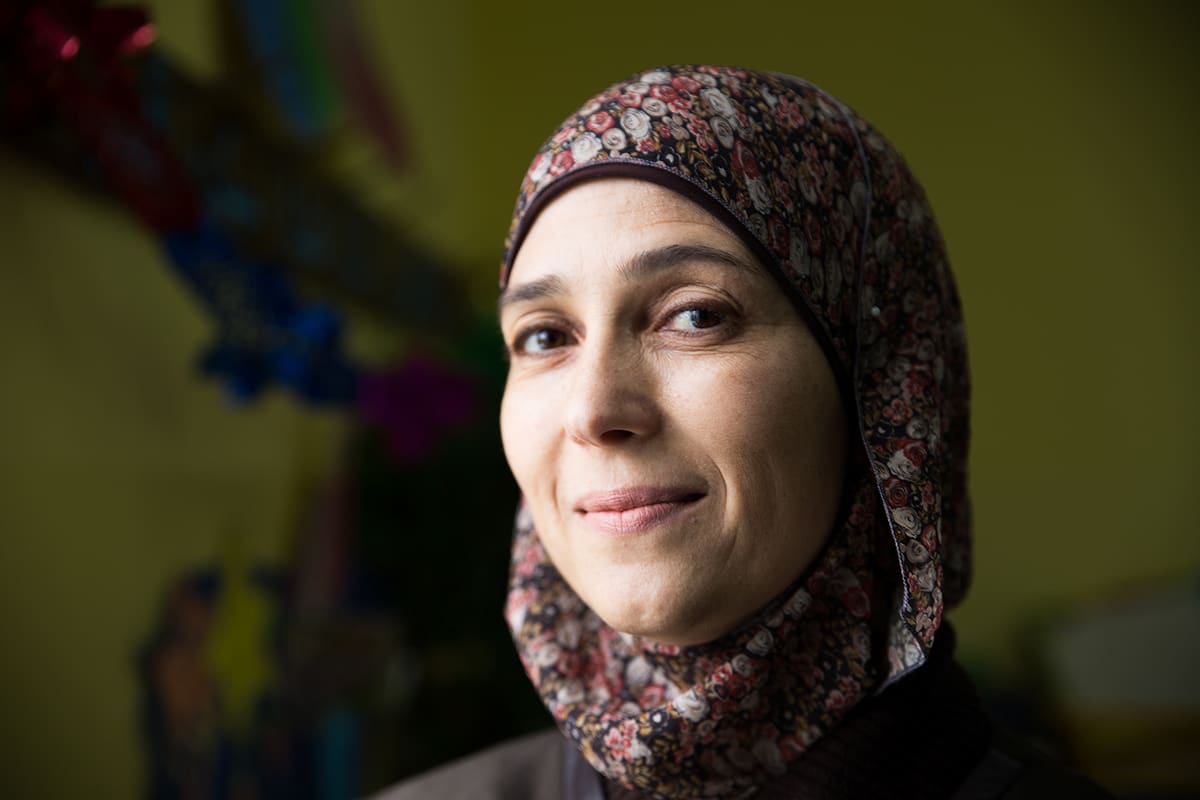
Palestiinalainen opettaja Hanan al Hroub on kehittänyt opetusta, jolla ehkäistään väkivaltaista käytöstä lapsissa. Karoliina Knuuti
658
, miten Gazan pommitukset ovat jättäneet jälkensä nuoriin. Jutun VR-version voit
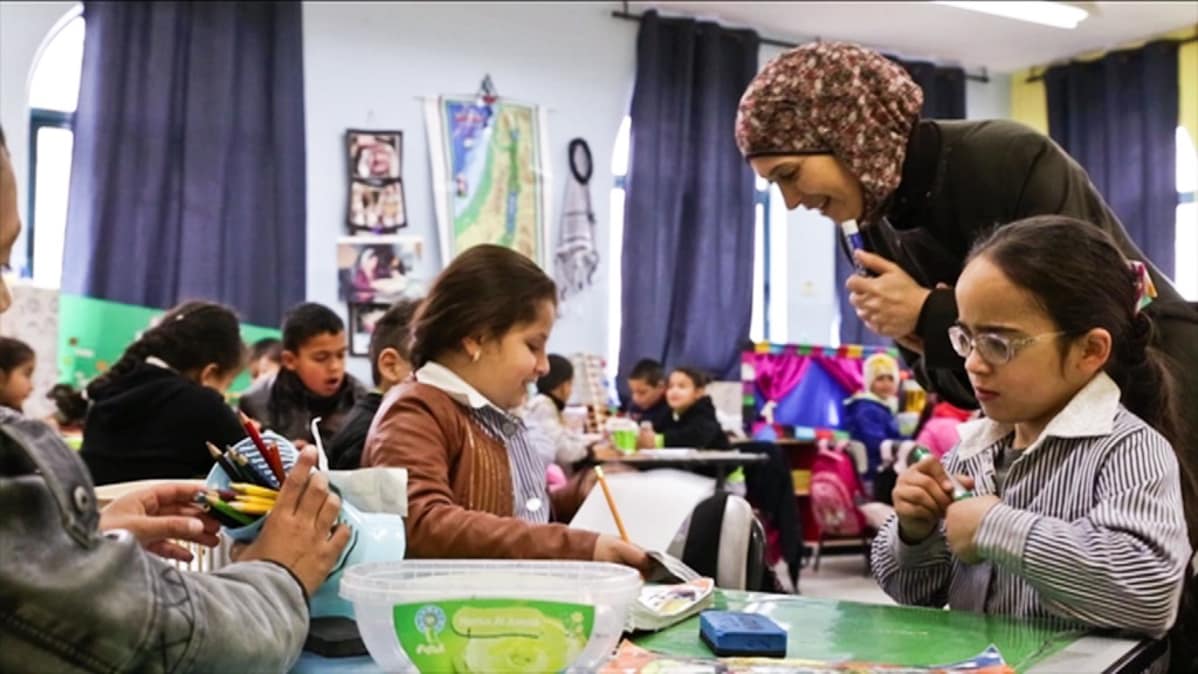
Kakkosluokkalaisten oppilaiden silmät ovat nauliintuneet naiseen, joka opettaa matematiikkaa nimensä avulla.
– Minun nimeni on Hanan. Jos “alif” -kirjaimesta saa seitsemän pistettä, niin montako pistettä nimestäni saa? nainen kysyy.
Hanan-nimessä – joka tarkoittaa arabiaksi myötätuntoa – on yksi arabian kieleen kuuluva alif-kirjain. Siis seitsemän pistettä.
Oikean vastauksen antanut oppilas saa taputukset koko luokalta.
Tämän jälkeen laskuharjoitukset jatkuvat palloleikillä.
Näin opettaa palestiinalainen Hanan al-Hroub, tuore Vuoden opettaja
. Vuosittaista palkintoa pidetään “opetusalan Nobelina”, jonka uusin voittaja valittiin maaliskuussa tuhansien ehdokkaiden joukosta.
Hanan al-Hroubin luokassa opiskelee 25 oppilasta.Karoliina Knuuti
Sekä oppilaat että 43-vuotias Hanan al-Hroub syntyivät keskelle sotilasmiehitystä.
Ollaan al-Birehin kaupungissa, kymmenen kilometrin päässä Jerusalemista ja muutaman kilometrin päässä Länsirannan muurista, joka erottaa palestiinalaiset ja israelilaiset toisistaan.
Opetan heille kiintymystä ja huolenpitoa. Opetan heitä rakastamaan toisiaan.
Miehitystä ei jaksa miettiä lasten hauskanpitoa katsellessa, ja se on tarkoituskin.
Al-Hroub sai Vuoden opettaja -palkinnon, koska hän loi oppilailleen rauhan saarekkeen keskelle vihan erämaata.
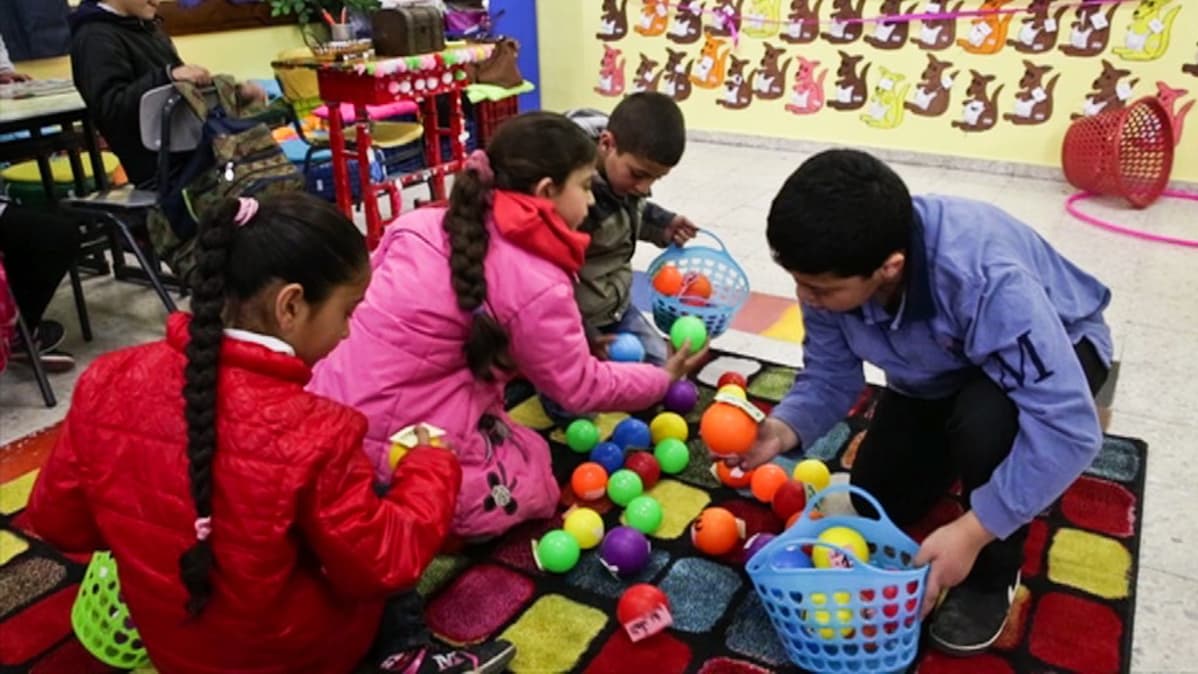
Värikäs luokkahuone pursuaa leikki- ja pelivälineitä. Al-Hroub käyttää niitä oppikirjojen tukena, sillä ne tekevät oppimisesta hauskaa.
Luokassa yhteistyökyvystä palkitaan ja oppilaita kannustetaan luottamaan toisiinsa.
– Opetan heille kiintymystä ja huolenpitoa. Opetan heitä rakastamaan toisiaan, al-Hroub kuvailee.
Al-Hroub opettaa rakkautta, koska hän tietää mitä vihalla saadaan aikaan.
Tie palkituksi opettajaksi alkoi kuitenkin juuri vihan hedelmästä – Israelin sotilaan laukauksesta.
Al Hroubin mukaan palestiinalaispojat omaksuvat jo varhain väkivaltaisia tapoja vastustaa Israelin turvallisuusjoukkoja.Karoliina Knuuti
Yhdeksän vuotta sitten al-Hroubin aviomies Omar oli matkalla kotiin perheen kahden pojan kanssa. Matkan varrella oli Israelin tarkastuspiste.
Alkoi ammuskelu. Yksi luodeista osui aviomiestä olkapäähän, toinen mukana ollutta veljen vaimoa päähän.
Fyysiset vammat eivät olleet vakavia. Todellinen kärsimys tuli vasta välikohtauksen jälkeen, al-Hroub kertoo.
– Lapseni traumatisoituivat. He muuttuivat hiljaisiksi ja heräsivät öisin huutaen isänsä nimeä. He eristäytyivät kaikista, jopa minusta.
Katsokaa luokkahuonettani. Näettekö vihaa täällä?
Kokemus muutti jotain myös al-Hroubissa. Hän päätti suorittaa loppuun juuri alkaneet opettajanopinnot, jotta voisi ryhtyä opettamaan lapsille rauhan, ilon ja luottamuksen sanomaa.
Sillä lapset imevät itseensä kaiken ympäristöstään. Myös väkivallan, jota miehitetyllä Länsirannalla piisaa.
– Yksikään lapsi ei synny viha sisällään, mutta hänen ympäristönsä vaikuttaa hänen käytökseensä. Kaikki mitä hän näkee, kaikki mitä hän kokee. Heidän ei tulisi todistaa tätä väkivaltaa, joka heitä ympäröi.
Al-Hroub kiistää
, joiden mukaan juuri viha israelilaisia kohtaan on se mitä palestiinalaiskouluissa opetetaan.
– Katsokaa luokkahuonettani. Näettekö vihaa täällä? Jos opettaja opettaa vihaamaan, hän itse on ensimmäinen joka kärsii siitä. Oppilaat vihaavat ensin häntä, sitten toisiaan. Lopulta kaikki kärsivät.
Israelin vankiloissa on satoja palestiinalaislapsia, joista enemmistö on otettu kiinni kivien heittelyn vuoksi.Karoliina Knuuti
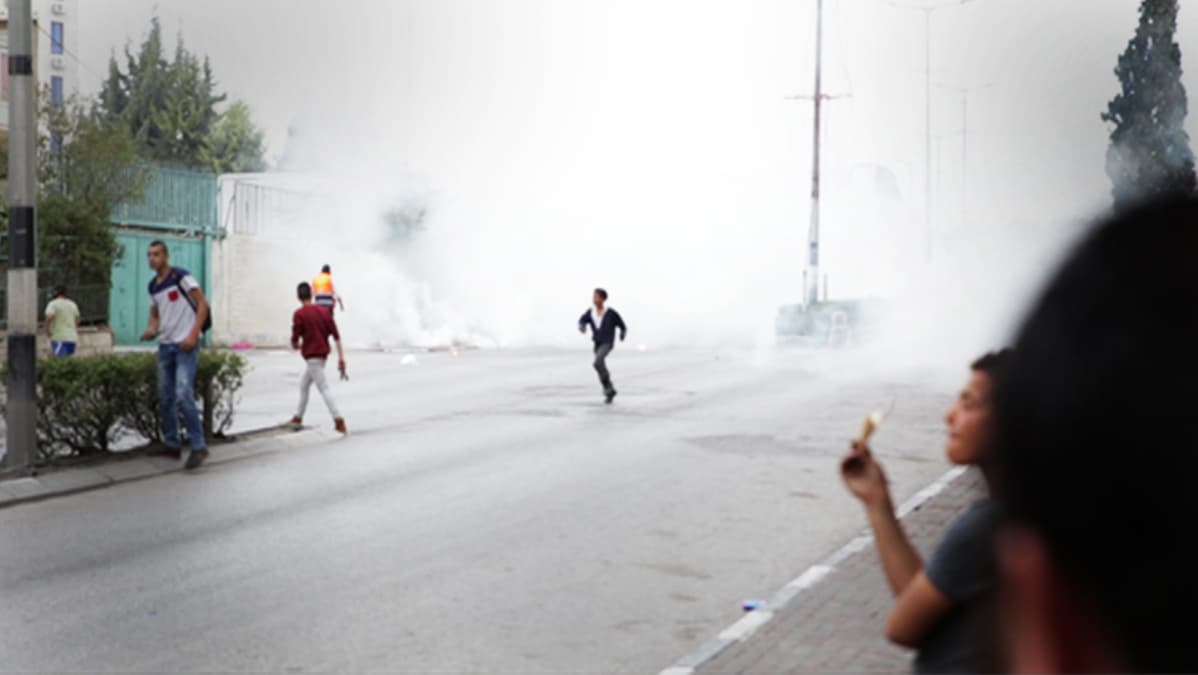
Palestiinalaislapsille ja nuorille Israel tarkoittaa muuria, miehitystä ja tarkastuspisteitä. Tavallisin kontakti israelilaiseen on käskyjä, kyynelkaasua ja kumiluoteja jakeleva sotilas.
Palestiinalaispojat oppivat jo alakouluiässä vastustamaan miehitystä omalla tavallaan, eli viskomalla kiviä sotilaita kohti.
Seuraukset ovat usein vakavia. Päähän osunut kumiluoti tai kyynelkaasukanisteri voi tappaa, ja kivien heittelijöitä viedään vankilaan.
Israelin vankiloissa oli joulukuun lopussa
, suurin osa kivien heittelyn vuoksi.
Toivoa on oltava aina. Meidän on elettävä.
Useimmat jättävät kivien heittelyn vanhetessaan, mutta jotkut tarttuvat veitsiin tai polttopulloihin.
Viime syksystä lähtien kiihtyneissä israelilaisten ja palestiinalaisten väkivaltaisuuksissa on tapettu 30 israelilaista ja yli 200 palestiinalaista, joista kymmenet ovat olleet alaikäisiä.
Al-Hroub toteaa, ettei mahda vuosikymmeniä jatkuneelle miehitykselle ja vihanpidolle mitään. Mutta luokkahuoneensa sisällä hän yrittää katkaista väkivallan kierrettä, jota sukupolvesta toiseen jatkuva miehitys ruokkii.
– Luokkahuone on lasten toinen koti. He viettävät puolet ajastaan täällä. Tavoitteeni on, että nämä oppilaat voivat elää lapsuuttaan tämän luokkahuoneen sisällä.
Länsirannan tulevaisuus ei kuitenkaan näytä valoisalta. Onko palestiinalaisilla toivoa?
– Toivoa on oltava aina. Se on tarpeeksi. Meidän on elettävä.
Al Hroub käyttää paljon leluja ja pelivälineitä opetuksen tukena. Karoliina Knuuti
Al-Hroub lähettää terveiset Suomeen. Ensin tietenkin kirkkonummelaiselle matematiikanopettajalle Maarit Rossille, joka oli yksi Vuoden opettaja -palkinnon kymmenestä finalistista.
Lopuksi al-Hroub sanoo ehdotuksensa Suomen luokkahuoneisiin, joissa tuhannet pakolaislapset aloittavat opintaivaltaan.
Osa lapsista on voinut asua Suomessa pitkäänkin, osa on saapunut Suomeen suoraan sodan keskeltä, halki Euroopan vieneen rankan vaelluksen jälkeen.
– Nämä lapset ovat psykologisesti vaikeassa tilanteessa. Ehdotan, että näiden lasten luokassa olisi opettajia sekä lähtömaasta että Suomesta. Koska uusi kulttuuri on niin outo lapsille, on hyvä, että heillä olisi opettajia eri taustoista, al-Hroub sanoo.
Apuna käytettäisiin luonnollisesti sotaa käyvistä maista paenneita opetusalan ammattilaisia.
– Näistä maista lähteneitä ihmisiä on yhteiskunnan eri osa-alueilta. On opettajia, tohtoreita, opiskelijoita. Opettajien yhteistyö luokassa antaisi oppilaille tasapainoa, al-Hroub neuvoo.
Mitä tapahtuu luokkahuoneissa tänään, vaikuttaa yhteiskuntaan tulevaisuudessa, al-Hroub muistuttaa. Siksi Suomeen tulleille on hyvä näyttää jo koulussa, että uusi kotimaa pitää heistä huolta.
– Jos lapset rakastavat ympäröivää yhteiskuntaa, he tulevat olemaan aktiivinen osa sitä.
Olen tähän asti ja tulen jatkossakin pitämään kunniavartioita kunnianosoituksena sotiemme uhreille.
Ei ole vahingossakaan edes vilahtanut mielessä, että nykyisenä aikana turvallisissa oloissa siitä jollekin tulisi trauma varsinkaan, kun jokainen vartiossa seisova on siellä itse vapaaehtoiseksi ilmoittautuneena.
Ilmeisesti vihreässä maailmassa ne vainajat aiheuttavat vammauttavan henkisen ”kentän”, minkä kautta vainajien kokemat kauhut välittyvät vartiossa seisovien mieleen aiheuttaen traumoja.
Ylen suuri suuri seksuaalihäirintäkeskustelu oli karmaisevaa kuultavaa ja vähän katsottavaakin.
Maailman sivu on seksuaalisesti häiritty naisia ja vähän miehiäkin (on omakohtaista kokemusta) ja siten on toteutettu Ison Kirjan käskyä täyttää tämä maa.
Luoja on luonut ihmisenkin ja varustanut hänet sukupuolivietillä. Nyt on tultu ihmiskunnan kehityksessä vaiheeseen, jossa sukupuolivietti täytyy panna naftaliiniin. Miten sitten ihmiskunta jatkuu, kun enää ei saa katsoa ainakaan sillä silmällä, koskettaminen on täysin kiellettyä ja vonkaaminen on vanhanaikaista. Tällaisia ajatuksia herätti Ylen suuri seksuaalihäirintäkeskustelu.
Tosin rajanveto oli tosi vaikeaa. Ja miksei olisi, kun meitä inehmoja on niin moneksi.
Kun meikä oli nuori ja siitä on jo aika kaukan, niin kyllä me pussattiin tyttöjä ja monet oli iloisia ja nauttivat siitä. Tosin aina oli joukossa joku nirppanokka, joka ei joko tykännyt tai sitten äiti oli kieltänyt pussailemasta poikia. Ei silloin kukaan tiennyt mitään seksuaalisesta häirinnästä, kun pääsääntöisesti oli kivaa.
Niin sitten löytyi se kumppanikin, jonka kanssa elettiin yhdessä melkein 50 vuotta, kunnes enkeli tuli ja vei kumppanin. Lapsiakin siunaantui ja lastenlapsia samalla menetelmällä, kuin Aatamilla ja Eevalla.
Joskus vaikuttaa siltä, että kun meillä esim. Suomessa on perustarpeet tyydytetty joitakin poikkeuksia lukuunottamatta, nii pitää keksiä kaikenlaista jonnin joutavaa.
Jos joku tulee kaltoin kohdelluksi, niin sitä varten on lait ja asetukset. Ei siitä tarvitsisi nostaa valtavaa älämölöä, kuten Yle eilen teki.
Omistusasunto ja haluat muuttaa joko työn perässä tai tilanteen vaatiessa itsellesi sopivampaan asuntoon esim iän karttuessa lähemmäksi palveluja:
– Tuumasta toimeen myy nykyinen asuntosi ja jos se on vähänkin syrjässä, niin se on myytävä halvalla joten saat tilalle ehkä nipin napin pienemmän asunnon.
– Lisää kuluja tulee varainsiirtoverosta jonka Kataisen hallitus korotti – Iltalehti tänään kannattaalukea jos olet muuttoaikeissa.
– Kuluja tulee myös, kun joudut hävittämään osan kertyneistä tavaroista jotka eivät mahdu uuteen pienempään ja sinne uuteen on hankittava uutta sopivampaa kalustoa esim.
– Omalla kohdalla päädyin muuttokuluina n 20.000,- ylimääräiseen kulunkiin ja nyt pienempi asunto on kalustettu osin niillä tuoduilla vanhoilla käymättömillä kaluilla.
Kaarina Hazard, Anu Koivunen: loputonta uhriuttaan jollottavat äijät.
Suomen tiede-elämää seuratessa järkyttyy päivittäin. Luettelo viimeisimmistä järkytyksen aiheista:
Suomalainen Tiedeakatemia on lähtenyt etupoliittisen ja piiloideologi- sen tutkimuksen tielle. Ajankohtainen esimerkki on metsien ja ilmaston yhteyksiä koskeva selvitys, erityisesti selvityksen kysymyksenasettelu ja rajaus.
Suomen Tiedeseura järjesti luennot suurimmista tieteellisistä löydöistä 100 vuoden ajalta. Yhteiskunnallisen ja humanistisen tutkimuksen luen- noissa kummastutti yhteen ”löytöön” tai osa-alueeseen umpioitumi- nen. Yhteiskunnan tutkimuksessa ainoa löytö muka on Max Weber ja kapitalismin henki. Ei yleiskatsauksellisuutta, ei laajempaa näköalaa, ei vertailevuutta muihin löytöihin, ei synteesiä. Tällaista ”huipputiedettä” Suomessa.
Tutkimuksen poliittinen ohjailu on Suomessa saanut järkyttävät ja pe-rustuslainvastaiset mitat. Poliittisen ohjailun välineeksi on nostettu Suomen Akatemia (valtion virasto). Poliittisen ohjailun välineenä toimii myös yliopistolaki sekä yliopistokentän muokkaaminen talous- ja poli- tiikkalähtöisesti, esimerkkinä Tampereen säätiöyliopiston perustamisen omavaltaiset ja laittomat menettelyt.
Sitrasta käytiin eduskunnassa periaatteessa hyvä sanasota mutta se jäi pinnalliseksi. Sitran toiminnasta tarvitaan sisältöanalyysi, joka koskee myös toiminnan ideologista tavoitteistoa.
Suomen Akatemiassa vireillä oleva Media ja yhteiskunta -hanke sekä samansukuiset hankkeet aiemmin.
Kukin näistä vaatii oman tutkiskelunsa. Tällä kertaa rajaudun viimeksi mainittuun eli Akatemian mediatutkimushankkeeseen.
Hankkeen nimi on siis Media ja yhteiskunta. Miksi tällainen hanke ollaan pystyttämässä? Mistä tällaisen hankkeen ideointi on lähtenyt liikkeelle? Mihin hankkeella pyritään? Millä oikeutuksella ja kenen hyväksi hankkeeseen käytetään akatemia-vetoista verorahaa?
Hankkeen pyrkimyksiä tai piilopyrkimyksiä ei joko lausuta julki tai lausutaan osittain tai sopivan abstraktisti niin että ne kuulostavat vastaansanomattomilta.
Aiemmat Akatemian hankkeet heittävät epäilyn varjon. Taannoin Aka- temialla oli valtatutkimushanke. Eläkejärjestelmän valtaa koskeva tut’ kimus annettiin Etlan tehtäväksi. Ei ole vaikea arvata saatuja ”tutkimus- tuloksia”. Parhaillaan Akatemia rahoittaa ja ohjaa media- ja kultuuritut- kijain populismi-tutkimusta, aineistona perussuomalaiset. Tuoreen jul- kaisun nimi on Jätkät & jytkyt. Hankkeen julkaisua on luonnehdittu Timo Soinin ylistykseksi, ei vähiten Soini itse. Kylläpä suomalainen poli- tiikan ja kulttuurin tutkimus uppoutuukin syvälle, sopisiko vertailukoh- daksi Aristoteles, Platon, Montesquieu, Tocqueville, Snellman, Rosan- vallon vai kuka? Populismi-hankkeen piilotavoite lie ollut toisaalla: oppia ennakoimaan populismin uusia aaltoja, hallita niitä ja hoidella ne pois. Kirjassa puhutaankin populismin elinkaaresta.
Varovaista osviittaa Media ja yhteiskunta -hankkeen piilotavoitteista saanemme oheisesta kuvasta. Kuva esittää hankkeelle kaavailtuja tee- moja. Siinä on yhteenniputettuna ’Some, nationalismi ja pop’ (populismi, populaari).Tiedeväen mielissä populismi ja nationalismi ovat negatiivisia ilmiöitä. Miksi sosiaalinen media (some) on niputettu yhteen negatiivis- ten ilmiöiden kanssa? Tämä kertonee Akatemian ja tutkijoiden asennoi- tumisesta, arvomaailmasta ja politikoinnista. Heidän mielissään some on tyhmän kansan, epätietämyksen, totuudenvastaisuuden ja vihapu- heen foorumi. Se täytyy pelata marginaaliin tai hävittää. Näin kenttä ja ‘laadukas’ toiminta jää oikean median, mediayhtiöiden, tiedeväen ja portinvartijoiden yksinoikeudeksi. Kyseessä on yhteiskunnallinen ja po- liittinen valtataistelu, jonka välineenä käytetään tiedettä ja tutkimusta. Sosiaalinen media (some) on yhteiskunnallisen opposition ja marginaa- liin asemoidun uusajattelun foorumi. Sen pohjalta voisi muotoutua uudenlainen yhteiskunta- ja demokratiakäsitys, myös tieteellisessä mielessä. Portinvartijoiden asemia ja etuja tämä saattaisi uhata tavalla tai toisella, siksi he taistelevat kehitystä vastaan, leimaavat somen hötöksi samalla tavalla kuin Petteri Orpo leimaa eduskuntaopposition puheet hötöksi tai kuten maailman köyhien vastarintaliikkeet leimataan terrorismiksi.
Suomalaisen Tiedeakatemian kokouksen 13.11.2017 painavin vaade tai argumentti kuului näin.”Oikeus tieteelliseen keskusteluun kuuluu kaikille, ei vain etabloidulle tiedeväelle.” Tämän lausui Ylen tiedetoimittaja Pasi Toiviainen – kiitos siitä. Tämä totuus tulkoon tieteellisen toiminnan graniittiseksi perustaksi.
Suomalaisen tiedepolitiikan ja Suomen Akatemian menettely tutkimus-hakkeiden ideoinnissa ja ohjailussa rikkoo kaikille kuuluvaa oikeutta tie-teelliseen keskusteluun. Ensinnäkin edellä mainittu epäily piilotavoitteis- ta.Toiseksi ohjausmenettely on erittäin hierarkinen ja rajattu. Akatemian väki asettelee teemat,kutsuu luotetut tutkijat kuulemaan teemoista, johtaa ns.työpajaa,asettaa haettavaksi rahat,tutkijat asemoidaan ane- lijoiksi. Akatemia käy läpi hakemukset, hyväksyy tai hylkää, on huolella valittu johtoryhmä joka valvoo mitä tutkijat tekee ja miten tekeminen vaikuttaa. Tutkijat ”ymmärtävät” mukailla, onhan heidän elantonsa ja elämisensä riippuvainen rahojen myöntäjistä. Hankkeiden perusteluihin iskostetaan läpinäkymätöntä retoriikkaa. ”Yhteiskunnallinen vaikutta- vuus on retorinen heitto kuten me kaikki täällä tiedämme”, lausui eräs- kin mediatutkija Akatemian työpajassa. Jos joku yritti avata, purkaa tai kysyä mikä se yhteiskunta oikeasti on ja mitä se vaikuttavuus on, vas- tauksena oli abstraktia mitäänsanomattomuutta tyyliin ”sen pitää olla laadukasta”.Laadukasta! Siinä kaikki,laadukasta.Tuo on höttöisempää puhetta kuin eduskuntaväittely ohuimmillaan.
Suomalaisen Tiedeakatemian tilaisuudessa 13.11. professori Anna-Liisa Laine vaati vaikuttavuus-puheesta irtautumista ja paluuta tieteellisen peruskysymisen äärelle. Tähän voi vain yhtyä. ”Vaikuttavuus” on poliit- tisen vallankäytön piilokieltä. ”Vaikuttavuutta” voi olla esimerkiksi se että mediayhtiöt kuten Sanoma, Alma, Keskisuomalainen, Lännen media, Suomen Kuvalehti saavat lisää valtaa eli vaikuttavuutta. Oppositio eli some ajetaan alas. Todellista winwin-vaikuttavuutta.
Tutkitaanko Akatemian hankkeessa myös mediatutkijoiden some-käyttäytymistä?
Katso oheinen kuva. Mediaprofessori Anu Koivunen ja kaverinsa tyk- käävät ja jakavat somessa Kaarina Hazardin tviittiä, jossa kerrotaan ”loputonta uhriuttaan jollottavista äijistä”.
Kysyn professori Koivuselta sekä Haapalaiselta ja Hazardilta, keitä he tarkoittavat ”loputonta uhriuttaan jollottavilla äijillä”? Miehiä ylipäänsä, meitä, sinua, minua? Syytös on yksilöimätön ja sellaisena se kohdistuu noin puoleen kansakunnasta.
Akateeminen tutkijakunta on ollut hanakas tuomitsemaan leimaavan vihapuheen. Jotkut tiedeväestä kehottavat hyökkäykseen totuuden-jälkeisyyksiä vastaan. Näin vaati Kari Enqvist yliopiston avajaispuhees- saan syyskuussa 2017. Enqvistin hyökkäyskehotusta kiitteli vuolaasti entinen rehtori ja kansleri Risto Ihamuotila Suomalaisen Tiedeakatemian kokouksessa 13.11.2017.
Ellei puhe ”loputonta uhriuttaan jollottavista äijistä” ole vihapuhetta, niin pyydän professori Koivusta julkisesti määrittelemään mikä on vi- hapuhetta. Vai onko puhe jollottavista äijistä kiihottamista kansan- ryhmää kohtaan, jollaisesta on oikeudessa tuomittu rangaistuksia.